Dandruff or fungus: how to tell them apart and what to do
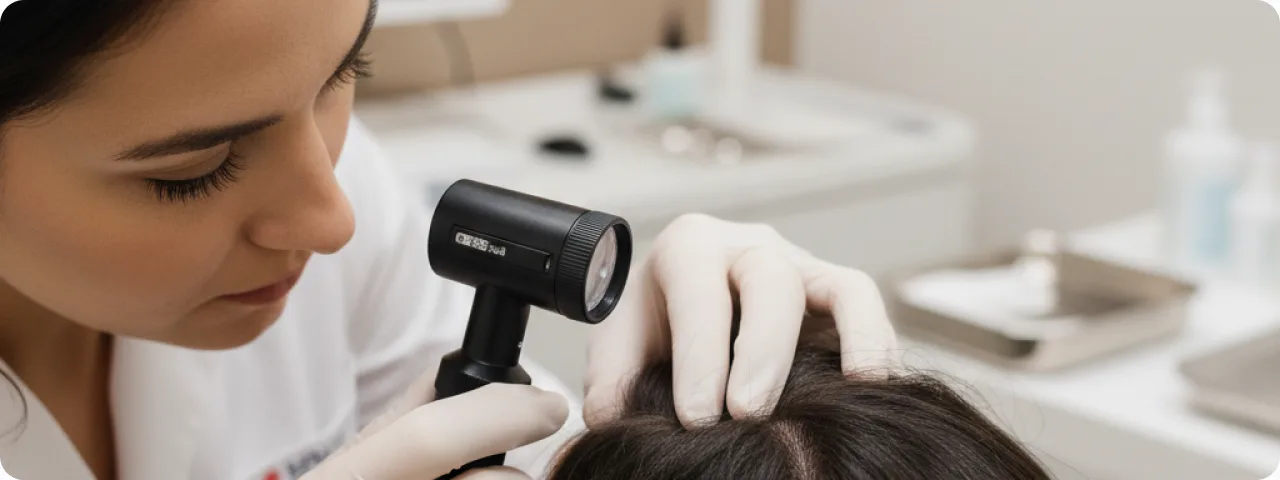
Dandruff and fungus — what is the difference?
Dandruff and a fungal infection of the scalp are two conditions that are often confused, because the symptoms are similar: flaking, itching, discomfort. Their nature, however, is fundamentally different, and so the treatment must be different too. Ordinary dandruff (pityriasis) is accelerated turnover of the cells of the epidermis, which can arise from dry skin, the wrong care routine, stress or hormonal changes. A fungal infection (tinea of the scalp) is an infectious disease caused by dermatophytes or yeast-like fungi. Incorrect self-diagnosis is the most common mistake patients make: a person treats "dandruff" with cosmetic shampoos for years, while the real cause is a fungal infection requiring antifungal therapy. This article looks at the key differences, the methods of diagnosis and the effective approaches to treating both conditions.
The main signs of ordinary dandruff
Ordinary dandruff has characteristic features that help to tell it apart from a fungal infection. Look out for these key signs:
- fine white or greyish flakes: they fall easily from the hair and are visible on dark clothing. They are usually distributed evenly over the whole scalp. They increase with dry air, frequent washing in hot water, or the use of harsh shampoos containing sulphates.
- moderate itching without inflammation: the scalp may itch, but there is no marked redness or swelling. The itching increases in the evening or after stressful situations. The skin between the flakes looks normal, with no sign of an inflammatory process — an important difference from fungus.
- seasonality and a link with stress: dandruff often flares in winter because of the dry air from heating, and during periods of nervous tension or dietary change. In summer the condition usually improves thanks to humidity and to ultraviolet light, which has a moderate antifungal effect.
- response to cosmetic care: ordinary dandruff responds well to specialised shampoos containing zinc pyrithione, selenium or ketoconazole. If there is no improvement after 3–4 weeks of regular use, that is reason to suspect a fungal cause and to see a dermatologist.
Signs of a fungal infection of the scalp
A fungal infection of the scalp has more pronounced and more localised features than ordinary dandruff. The main signs are: sharply demarcated areas of involvement with redness and swelling of the skin, and large yellowish or greyish scales that adhere firmly to the skin and are hard to remove. Hair in the affected area becomes dull and brittle and may break off at the root, forming characteristic stubs. In tinea capitis (trichophytosis) round bald patches with clear borders appear. In microsporia the patches have a greyish coating. Favus produces yellow crusts (scutula) with a characteristic unpleasant smell. The fungus can spread to other areas of the body — the eyebrows, the eyelashes, the skin of the face. Unlike dandruff, a fungal infection does not clear on its own and progresses without treatment.
Diagnosis: how the cause is established
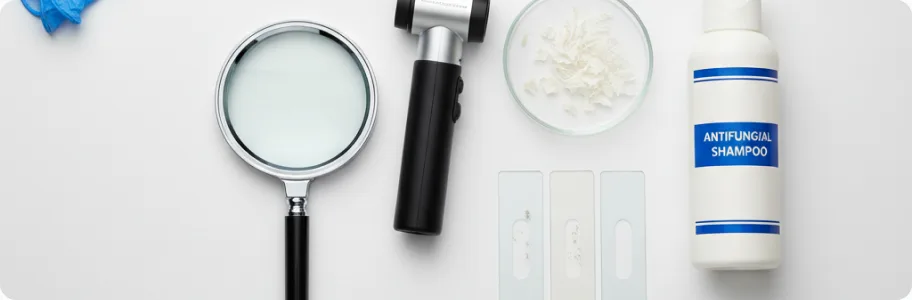
Accurate diagnosis is the key to effective treatment. A dermatologist uses a combination of methods to distinguish dandruff from fungus. Wood's lamp (ultraviolet examination) — fungal lesions fluoresce characteristically: greenish in microsporia, dull in trichophytosis. Microscopy of a scraping — a sample of scales and hair is examined under a microscope for fungal spores and mycelium. Culture — the material is plated on a special medium to identify the species and its sensitivity to drugs (a result in 2–4 weeks). Trichoscopy — digital dermatoscopy shows the state of the hair follicles, the vessels and the surface of the skin under magnification. PCR is the most accurate method, detecting fungal DNA even when very little of the organism is present.
Treating dandruff: what works
Treatment of ordinary dandruff begins with adjusting the care routine and lifestyle. First of all, choosing a shampoo with active ingredients: zinc pyrithione (regulates the microbiome), salicylic acid (exfoliates dead cells), selenium sulphide (slows epidermal turnover), tar (anti-inflammatory). The medicated shampoo is applied to the scalp for 3–5 minutes before rinsing, in a course of 4–6 weeks. It is important to get the washing frequency right: more often for oily dandruff, less often for dry dandruff with the addition of moisturising products. Diet also matters: limit sugar, white bread and alcohol, which stimulate sebum production. Increase your intake of omega-3 fatty acids, zinc and B vitamins. If there is no improvement within 4–6 weeks, that is a signal to see a dermatologist for further assessment.
Treating a fungal infection of the scalp
A fungal infection requires comprehensive medical treatment supervised by a dermatologist. The basis of therapy is systemic antifungal drugs (terbinafine, itraconazole, fluconazole), taken for 4 to 12 weeks depending on the species of fungus. Topical treatment includes shampoos with 2% ketoconazole, ciclopirox or sertaconazole, used 2–3 times a week alongside oral therapy. Where the inflammatory lesions are marked, the doctor may prescribe a short course of topical corticosteroids to reduce swelling and itching. Important: treatment must not be stopped at the first sign of improvement — fungal spores remain viable for weeks, and stopping therapy early leads to relapse. A follow-up scraping is taken 2 weeks after the course ends to confirm that the organism has been eradicated. Personal items (combs, hats, towels) should be disinfected or replaced.
Related reading
Did not find the answer to your question?
Every case is individual. If you have noticed changes in your skin, or have symptoms that concern you, book a consultation.