Athlete's foot: causes, symptoms and effective treatment
What is athlete's foot and why does it occur?
Tinea pedis (athlete's foot) is a fungal infection of the skin of the feet, caused mainly by dermatophytes (Trichophyton rubrum, T. mentagrophytes, Epidermophyton floccosum). Statistically it is the most common fungal skin infection in the world — 15–25% of the adult population are affected, and up to 70% of athletes and military personnel. Infection is acquired by contact: through infected skin scales on the floors of public showers, swimming pools, saunas and gyms, and through shared footwear and towels. The main risk factors are: excessive sweating of the feet (hyperhidrosis), wearing tight or synthetic shoes, maceration of the skin between the toes, diabetes, impaired peripheral circulation, obesity and immunodeficiency. The warm, damp environment inside closed shoes creates ideal conditions for fungi to grow.
Symptoms of athlete's foot
Athlete's foot has several clinical forms, each with its own characteristic features. The main symptoms include:
- interdigital (intertriginous) form: the most common variant — it begins with fissures, maceration and peeling of the skin between the toes, mainly between the 3rd and 4th and the 4th and 5th toes. The skin becomes whitish and swollen, and painful erosions and cracks appear. Patients complain of severe itching and burning, particularly after taking their shoes off.
- squamous hyperkeratotic (moccasin) form: affects the sole, the heels and the sides of the feet. The skin becomes dry and thickened, with fine flaking and painful cracks on the heels. Over a long course, the characteristic moccasin pattern forms — continuous thickening of the skin of the sole with powdery scaling. This form is often chronic and hard to treat.
- dyshidrotic (vesicular) form: characterised by clusters of blisters 2–5 mm across on the arch of the foot, on the toes and between them. The blisters contain clear or cloudy fluid and are accompanied by intense itching. When they burst, weeping erosions form. If a bacterial infection is added, the contents of the blisters become purulent.
- minimal (subclinical) form: the most hidden variant — it shows only slight flaking and a few small fissures in the interdigital folds, mainly between the 4th and 5th toes. Symptoms are minimal or absent. This form often goes unnoticed, but it is a source of infection for others and can progress to more marked forms.
Diagnosing athlete's foot
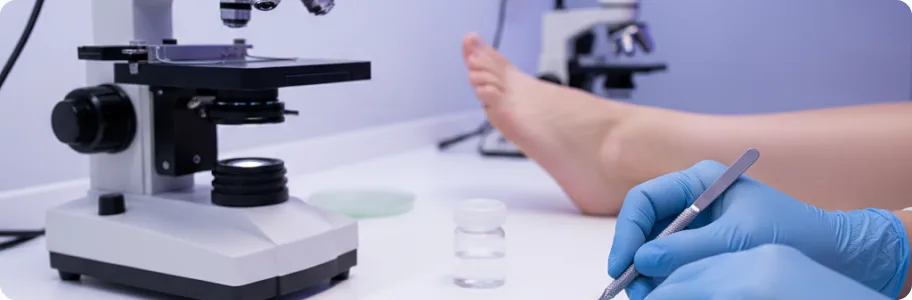
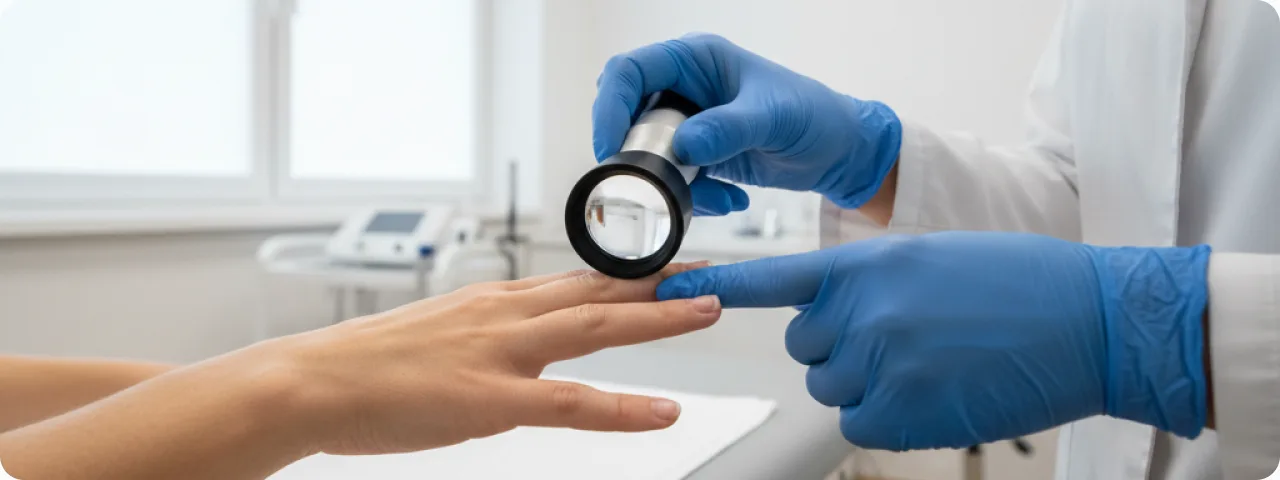
Diagnosis begins with examination and the history. Microscopy with a KOH test is the basic method: a skin scraping from the foot is treated with a 10–20% potassium hydroxide solution and examined under the microscope for fungal hyphae and spores. Culture (on Sabouraud medium) is the gold standard: it identifies the species and determines sensitivity to antifungals, with a result in 2–4 weeks. PCR is a rapid molecular method of identifying the organism's DNA with a sensitivity of up to 95% within 24–48 hours. Dermatoscopy is a non-invasive way of visualising the skin changes and helps to distinguish tinea from eczema, psoriasis and contact dermatitis. Examination under a Wood's lamp gives characteristic fluorescence in some forms. It is important to distinguish athlete's foot from eczema, psoriasis, contact dermatitis and dyshidrosis.
Current treatment of athlete's foot
Treatment depends on the clinical form and the extent of involvement. Topical therapy (the basis of treatment): terbinafine (1% cream or spray) — applied 1–2 times a day for 2–4 weeks, with effectiveness in dermatophyte infection of up to 80–90%. Clotrimazole (1% cream) — twice a day for 4–6 weeks. Ketoconazole (2% cream) — once a day for 4–6 weeks. Miconazole, isoconazole and sertaconazole are alternative azoles with proven effectiveness. Systemic therapy (in extensive and resistant forms): terbinafine (250 mg/day) — a course of 2–6 weeks, the drug of choice. Itraconazole (200 mg/day) — a course of 2–4 weeks or pulse therapy. Fluconazole (150 mg/week) — a course of 4–6 weeks in resistant forms. Combined therapy (a systemic plus a topical antifungal) substantially increases effectiveness, particularly in the moccasin form. In addition: antiseptic foot baths and drying preparations in weeping forms.
Prevention and skin care
Prevention is the key element in dealing with athlete's foot. Wear your own footwear (rubber sandals) in public showers, swimming pools, saunas and gyms — this is the main route of infection. Choose shoes made of natural materials (leather, textile) and avoid tight or synthetic shoes that do not let air through. Change your socks daily (or more often if you sweat heavily), preferring cotton or wool. After washing, dry the feet thoroughly, especially between the toes — moisture is the main provoking factor. Use an antifungal powder or spray to treat the feet and footwear preventively. Disinfect shoes with a UV steriliser or with specific products (chlorhexidine, "Mikostop"). Do not use other people's shoes, towels or manicure instruments. Support your immune system: a balanced diet, control of blood sugar in diabetes, and support of peripheral circulation. After treatment has finished, continue applying an antifungal cream preventively 1–2 times a week for 2–3 months.
When to see a dermatologist
See a dermatologist if you notice persistent flaking, fissures or redness of the skin of the feet, particularly between the toes. An immediate consultation is needed if blisters, weeping erosions, purulent discharge or marked swelling appear — this may indicate an added bacterial infection (cellulitis, erysipelas). See a doctor without fail if you have diabetes, impaired circulation in the lower limbs or immunodeficiency — in such patients athlete's foot can lead to serious complications, including trophic ulcers and sepsis. See a specialist too if self-treatment with over-the-counter products has produced no result within 4 weeks, if the infection recurs after treatment, or if it has spread to the nails or to other parts of the body.
Related reading
Did not find the answer to your question?
Every case is individual. If you have noticed changes in your skin, or have symptoms that concern you, book a consultation.