Contact dermatitis: allergy or irritation?

What is contact dermatitis?
Contact dermatitis (CD) is an inflammatory skin disease caused by direct contact with an irritant or an allergenic substance. It is one of the most common occupational skin diseases, accounting for up to 90% of all work-related dermatoses. Two main types are distinguished by mechanism: irritant and allergic contact dermatitis. The first accounts for about 80% of cases and the second for 20%, but it is the allergic form that is the more treacherous, because of the mechanism of immune sensitisation.
Allergic versus irritant: the key differences
Understanding the difference between the two forms of contact dermatitis is critical for correct treatment and prevention:
- irritant CD: develops without the involvement of the immune system, directly from damage to the skin barrier by chemicals (soap, solvents, acids). The reaction develops at the site of contact within minutes or hours.
- allergic CD: a delayed-type hypersensitivity reaction (type IV in the Gell and Coombs classification). It requires prior sensitisation: the first contact with the allergen is symptomless, and the reaction appears on re-exposure after 24–72 hours.
- the most common allergens: nickel (jewellery, buttons), fragrances in cosmetics, preservatives (methylisothiazolinone), latex, paraphenylenediamine (hair dyes), chromium (cement, leather goods), neomycin and balsam of Peru.
- risk factors: frequent hand washing, working with chemicals, a history of atopic dermatitis, broken skin, a damp environment, wearing rubber gloves for more than 2 hours, and a genetic predisposition to allergic reactions.
Clinical presentation and symptoms
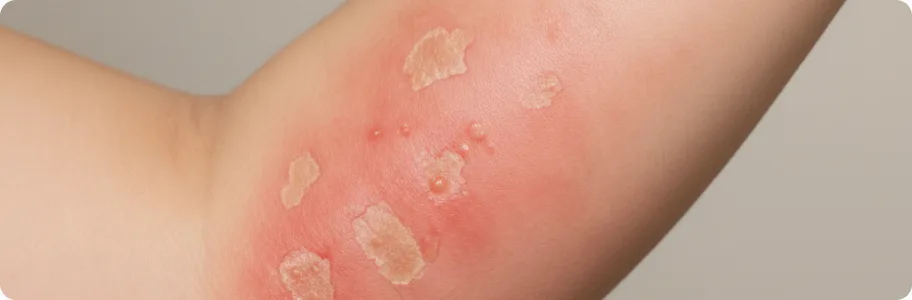
Irritant CD presents with sharply demarcated erythema, dryness, fissures and burning in the area of contact. Allergic CD is characterised by a polymorphic rash: erythema, swelling, papules, vesicles with serous contents and weeping in the acute phase. A characteristic feature is spread of the rash beyond the area of contact and the possibility of generalisation. Itching is the dominant symptom of the allergic form, whereas pain and burning dominate the irritant one. In the chronic course of both forms, lichenification, hyperkeratosis and fissures develop.
Diagnosis
The gold standard for diagnosing allergic CD is patch testing: a standard series of 25–30 allergens is applied to the skin of the back for 48 hours, and the results are read at 48 and 96 hours. A positive reaction (erythema, papules, vesicles) confirms sensitisation. Dermatoscopy is used in addition, along with specific IgE testing where contact urticaria is suspected, and provocation tests (ROAT — repeated open application test). The differential diagnosis includes atopic dermatitis, fungal infections, psoriasis and dyshidrotic eczema.
Treatment and prevention
The first and most important step is elimination of the causative agent — completely avoiding contact with the allergen or irritant. Topical corticosteroids of medium and high potency (mometasone, betamethasone) are prescribed in courses of 7–14 days. Where there is weeping, compresses with Burow's solution are effective. Calcineurin inhibitors (tacrolimus 0.1%) are suitable for long-term treatment on the face and in the folds. Systemic corticosteroids (prednisolone 0.5–1 mg/kg) are indicated in severe generalised forms. Barrier creams and protective gloves are the basis of occupational prevention.
When to see a doctor
See a dermatologist if the rash does not clear within 2–3 weeks after contact with the suspected substance has stopped, if the symptoms recur for no obvious reason, if a large area of the body or a sensitive area (the face, the genitals) is affected, and where an occupational cause is suspected — for patch testing and for the relevant documentation.
Related reading


Did not find the answer to your question?
Every case is individual. If you have noticed changes in your skin, or have symptoms that concern you, book a consultation.