Trichoscopy: modern diagnosis of hair disorders
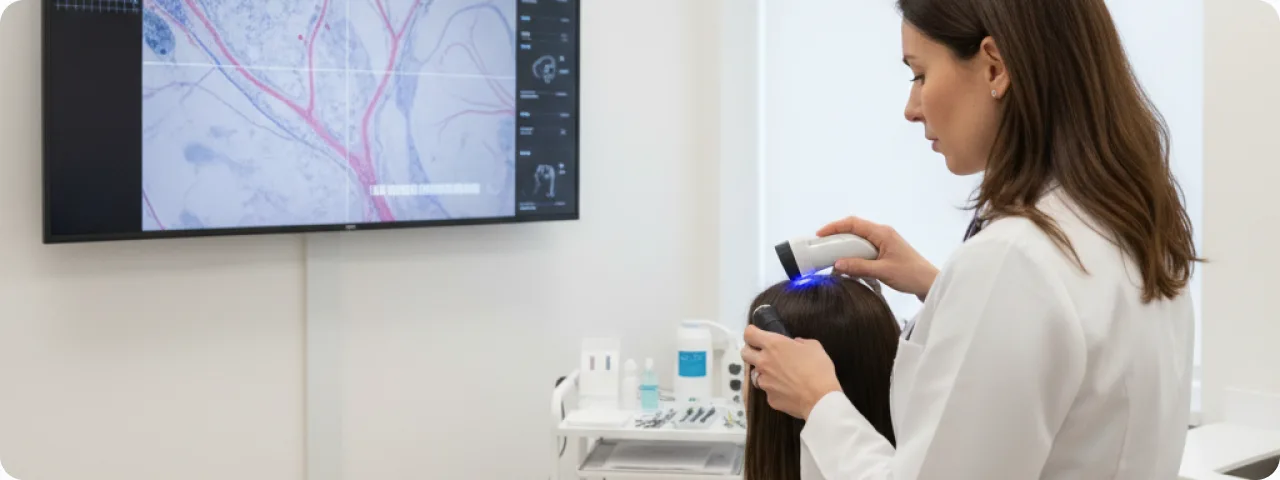
What is trichoscopy?
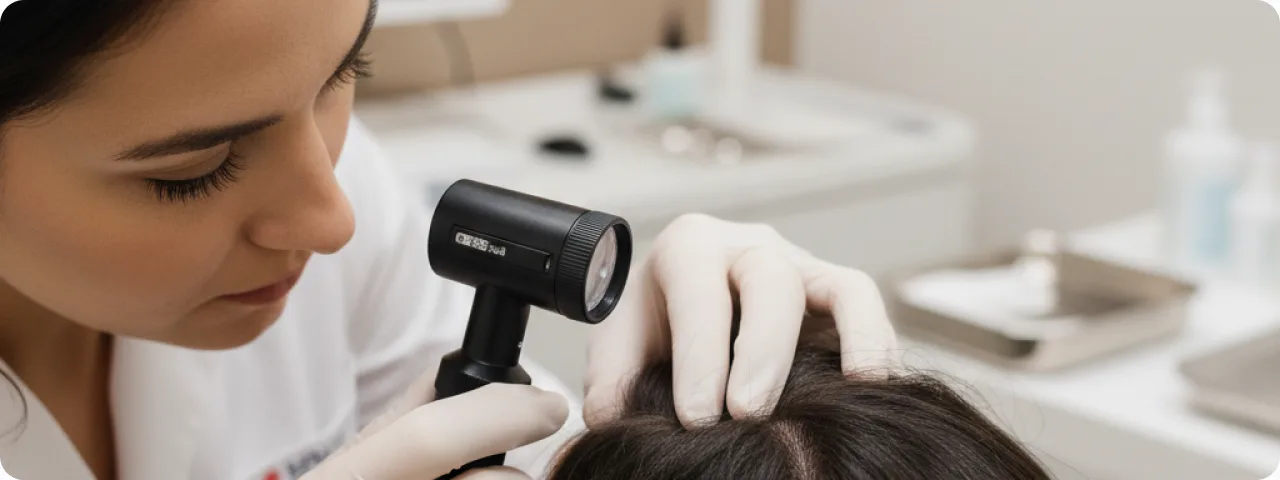
Trichoscopy is a non-invasive method of assessing the hair and scalp using a digital dermatoscope at 20–200 times magnification. It allows the structure of the hair shaft, the state of the follicular openings, the microvascular network and perifollicular changes to be visualised. Trichoscopy is the gold standard for the initial diagnosis of alopecia, because it gives an objective picture without pain or injury. The findings are recorded as digital images and stored in the patient's file for follow-up and for comparison before and after treatment.
Indications for trichoscopy
Trichoscopy is recommended for any complaint about the hair or scalp. The main indications include:
- diffuse hair loss: even thinning across the whole scalp, often related to stress, trace element deficiency or hormonal change. Trichoscopy reveals characteristic signs — variability in shaft diameter and an increased proportion of telogen hairs.
- androgenetic alopecia: the inherited form, in which trichoscopy documents progressive miniaturisation of the follicles, a reduction in hair diameter and the appearance of perifollicular pigmentation — "brown dots" and "yellow dots".
- alopecia areata: an autoimmune disease in which trichoscopy reveals pathognomonic signs — black dots (cadaverized hairs), exclamation mark hairs and yellow dots within the patches.
- scalp diseases: seborrhoeic dermatitis, psoriasis, lichen. Trichoscopy helps to distinguish these conditions by their specific patterns of scaling, vascular changes and the state of the follicular openings, without the need for a biopsy.
How the examination is carried out
Trichoscopy takes 15–30 minutes and is completely painless. The trichologist applies immersion oil or gel to an area of the scalp for better visualisation and places the dermatoscope on several zones — frontoparietal, temporal, occipital and vertex. The images are displayed on a monitor in real time at 50–200 times magnification. Software automatically analyses hair density (the number per cm²), the mean shaft diameter, the ratio of anagen to telogen hairs and the state of the skin. The findings are compiled into a detailed report with photographic documentation.
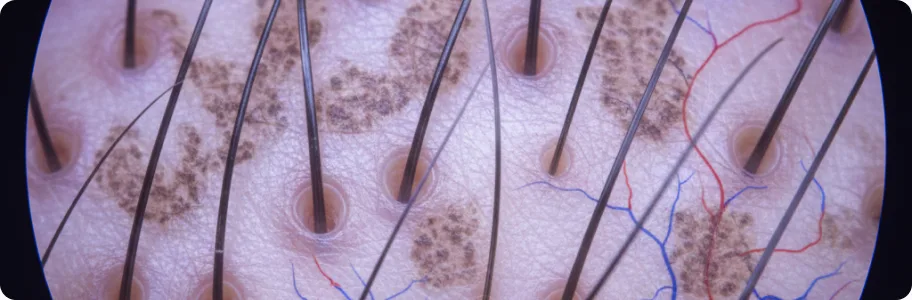
What trichoscopy shows
Trichoscopy provides objective data for an accurate diagnosis. The main parameters assessed are: hair density (normally 150–250 per cm²), the percentage of vellus (miniaturised) hairs, shaft diameter (normally 50–80 µm), the state of the follicular units and the number of hairs in each. The doctor analyses the vascular pattern — the presence of looped, dotted or arborising vessels, which point to different conditions. Besides diagnosis, trichoscopy is used to monitor the effectiveness of treatment: repeating the examination after 3–6 months allows progress to be assessed objectively and the treatment to be adjusted.
Phototrichogram and digital analysis
The phototrichogram is an extended form of trichoscopy that includes assessment of the phases of hair growth. On a small area (1 cm²) the hair is trimmed and photographed again after 2–3 days. Hairs that have grown are in the anagen (active growth) phase, while hairs that are unchanged are in the telogen (resting) phase. The normal anagen:telogen ratio is 85–90% to 10–15%. Modern software (TrichoSciencePro, FotoFinder) calculates these figures automatically and produces three-dimensional density maps. The results are stored in the patient's electronic record, which allows a comparative analysis at every subsequent visit.
The advantages of trichoscopy
Trichoscopy is a non-invasive, painless and quick method of diagnosis that requires no special preparation by the patient. Unlike a biopsy, it leaves no scars and can be repeated any number of times. It provides an objective assessment of the hair to within micrometres, which removes the subjectivity of visual examination. Digital recording of the findings makes it possible to follow the course of treatment and to show the changes to the patient.
Related reading
Did not find the answer to your question?
Every case is individual. If you have noticed changes in your skin, or have symptoms that concern you, book a consultation.